
Germany is the largest economy in Europe and home to about 84 million people. For an American, the practical picture is this: lower day-to-day costs than most of the US outside the biggest cities, strong public healthcare, and universities that charge little or nothing.
The trade-off is high income taxes, a fair amount of bureaucracy, and the expectation that you’ll learn German if you plan to stay long term. Germans tend to be reserved at first and value order and punctuality, so daily life runs on rules you’ll be expected to follow too.
What’s life like in Germany?
Germany’s people
Germany is a diverse country, with large immigrant communities from around the world alongside its German-born population. As anywhere, you’ll meet every kind of person.
Americans sometimes arrive expecting Germans to be unfriendly or cold. That reputation is misleading. Germans are often more reserved than Americans when they first meet you and less outwardly chatty, but they tend to value family and community highly, and they warm up once they know you.
The rule-follower reputation, on the other hand, is largely accurate. Order and efficiency matter here, and as a resident you’re expected to follow the same rules everyone else does: recycle correctly, keep noise down at night, and show up on time.
Geography
Germany’s landscape varies a lot from north to south. The north is mostly flat plains running up to the Baltic and North Sea coasts. The center and south are greener and hillier, with dense forests, mountains, and rivers.
The main rivers are the Rhine, Main, and Danube. In the far south you reach the Alps, along with Germany’s 484-kilometer Alpine Road. The east is more agricultural, though cities are spread across the whole country.
Germany’s climate
Germany’s climate is closest to the Pacific Northwest or British Columbia: temperate and fairly wet, with cool, overcast winters and warm summers, and four distinct seasons. The alpine south has a colder mountain climate.
Living in Germany as an American
Germany works well for Americans moving abroad. Anti-American sentiment is uncommon, and there are plenty of fellow expats to connect with. You can ease the transition through expat communities online, German-American cultural centers, or local Facebook groups.
Retiring in Germany
You can retire to Germany, but there’s no dedicated retirement visa the way Portugal, Spain, and others have. As a US citizen you can enter visa-free for 90 days and apply from within Germany for a general residence permit, which means showing you have enough pension income to support yourself, often around €1,200 a month for one person, without relying on German social support. You’ll also need comprehensive health insurance. Smaller cities will keep your costs well below a typical US equivalent.
The residence-permit route depends on your circumstances, so getting professional advice on your situation makes sense. See our Germany visa and residence guide for the details.
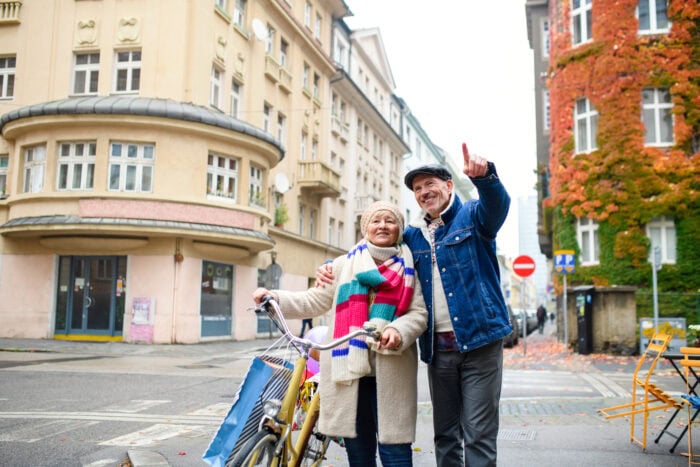
Cities in Germany
Best cities in Germany to live
Germany has plenty of cities worth considering, and the right one depends on whether you’re prioritizing work, study, or cost.
Berlin is the largest, at over 3 million people, and it draws expats and younger residents. It has long been cheaper than other major German cities, though rents have risen sharply in recent years and its reputation as a bargain capital is fading. Roughly a third of the city is green space and forest, so it’s an easy place to get outdoors.
Munich has the highest cost of living in the country, but it also has the most jobs, driven by tech, automotive, and finance. It’s home to two of Germany’s top universities, the University of Munich and the Technical University of Munich. Close to a third of residents were born outside Germany, which makes it comfortable for newcomers. It also hosts the world’s largest Oktoberfest.
Frankfurt suits people coming to study internationally or work in finance. It’s the country’s financial center, several of its universities focus on international business, and it employs a lot of its own graduates. Unemployment is low, and the location makes the rest of Western Europe easy to reach.
If you want a slower pace, Nuremberg is worth a look. It’s a major tourist city, which means more English-speaking job openings, and that combination makes it one of the easier German cities for foreigners to settle in.
Languages in Germany
The main language is German. Most children start learning English in school, and in the big cities you’ll find plenty of people who speak it. Germany ranks among the strongest countries in the world for English, fourth on the 2025 EF English Proficiency Index.
You’ll also hear French, Italian, and Russian, and in some areas Turkish and Kurdish are common.
Do you need to speak German to live in Germany?
Some expats manage without much German, but it’s worth learning anyway. Classes are widely available, and even a few basic phrases go a long way with locals:
- Please: bitte
- Thank you: danke
- Excuse me: entschuldigen Sie
If you plan to work, start learning as early as you can, since most employers will expect it. For long-term residency or citizenship, you’ll need to pass a German language test.
Accommodation in Germany
Renting
Where you live drives your rent more than anything else. As in the US, big cities cost far more than smaller towns. Stuttgart, Frankfurt, Düsseldorf, and Munich are the most expensive, while smaller cities like Nuremberg and Leipzig are more affordable. Berlin is still relatively cheap for a capital, helped by Germany’s rent brake (the Mietpreisbremse), which limits how much rent can rise when an apartment is re-let, though rents there have been climbing.
The upfront cost works differently than in the US. Instead of first and last month plus a deposit, you can be asked for a security deposit of up to three months’ rent at the start, so budget for a larger sum at signing.
Many apartments come completely unfurnished, which in Germany can mean no light fixtures, curtains, or kitchen appliances. Check exactly what’s included before you sign a lease. Flat-sharing is another option that makes the move cheaper and a bit easier.
Can expats buy a home in Germany?
Yes, though you may need a larger down payment than a local. The typical down payment is around 20 percent, but expats are often asked for 30 to 40 percent because lenders see them as higher risk. German homes tend to be smaller than American ones but are usually well built and energy-efficient, which helps keep utility bills down.
Getting around – transport in Germany
In the major cities, you can get almost everywhere on public transport. Trains and buses are clean, frequent, and reasonably priced, and plenty of city residents skip car ownership altogether or rarely drive for their daily commute.
Cycling is popular too. Most cities have extensive bike lanes, which makes commuting by bike practical.
Owning a car costs more than in the US. Gas is heavily taxed, running around €1.90 a liter as of mid-2026, roughly double what most Americans pay at the pump, so cars tend to be more fuel-efficient and people drive less. One upside: Germany’s autobahns don’t charge passenger cars tolls, so road trips around the country are straightforward.
Air travel
Germany is one of Europe’s busiest aviation hubs, with major international airports at Frankfurt and Munich and good connections from cities like Düsseldorf and Hamburg. That gives you a wide choice of airlines and routes, and cheap flights across Europe, to the UK and US, and beyond are easy to find year-round. Lufthansa is the main German carrier, with a low-cost arm, Eurowings. Berlin is now served by Berlin Brandenburg Airport (BER), which replaced the old Tegel and Schönefeld airports.
Health and Healthcare in Germany
Germany has a strong public healthcare system available to all residents, and it’s a big reason quality of life is high and life expectancy ranks among the better countries in the world. If you work in Germany, you’ll pay into the public health scheme automatically and can use it.
You can also take out private insurance, either to supplement public cover or, in some cases, to replace it. There are plenty of expat health insurance options, and the right one depends on how long you’ll stay and where you plan to travel within the EU, so it’s worth comparing before you commit.
Some visas and residence permits require you to hold comprehensive health coverage.
Cost of living in Germany
For most Americans, day-to-day costs in Germany are lower, though by how much depends heavily on where you live and how you spend. Groceries and eating out are often cheaper, and in Berlin some everyday costs can run close to half what you’d pay in a comparable US city.
The picture evens out once you account for taxes and big-city housing. A meal out or a coffee is roughly in line with US prices, so the savings aren’t across the board. Where Germany pulls clearly ahead is on the things that cost Americans the most: healthcare, education, and transport.
How much money do you need to live comfortably in Germany?
It depends on your choices. A high-spending life in central Frankfurt costs far more than a quieter life in a smaller town.
Healthcare is much cheaper than in the US, dramatically so on the public system but also in the private sector. Public universities are free or charge only a few hundred euros per semester. In the big cities you can rely on buses and trains instead of a car, and a Bahncard pays for itself if you commute by rail. These public benefits are funded through income tax, so as a worker you’re paying into them indirectly rather than getting them free.
Housing is the wild card. A city-center apartment in Munich or Stuttgart will cost a lot, while flat-sharing or a smaller city like Nuremberg keeps rent down.
Safety in Germany
Germany is a safe country for residents and newcomers alike. The main thing to watch for is petty theft. In a populous country with big cities, pickpockets work crowded spots like buses, train stations, and busy markets, and they target tourists in particular.
A bit of common sense goes a long way. Keep your wallet or purse secured and don’t leave valuables unattended, even once you’re a resident. No country is risk-free, but Germany consistently scores well on international safety rankings.
Money, Work, and Education
Currency and cash
Germany is in the European Union and uses the euro. The euro-to-dollar rate moves around, so check the current rate before you budget.
Germany relies on cash more than many other developed countries. Plenty of restaurants and shops still take cash only, and not every card works everywhere, so it pays to carry euros even though card acceptance is slowly growing.
Taxes in Germany
Like most of Europe, Germany charges VAT on goods and services, at a standard rate of 19 percent. That’s lower than several neighboring countries, but it’s built into prices.
If you live and work in Germany you’ll pay income tax. The rate rises with income, from 14 percent up to a top marginal rate of 42 percent, and 45 percent on very high earnings, with an added solidarity surcharge for high earners. The trade-off is that this funds public healthcare and largely free higher education, but it can be a shock if you’re used to taking home more of your US paycheck.
There’s also a church tax for registered members of certain religious communities, including Catholics, Protestants, and Jews. It runs 8 to 9 percent of your income tax bill, not of your income, depending on the state.
Working in Germany
Germany has one of the lowest unemployment rates in the EU, and most jobs are in the larger cities. If you’re a skilled worker from outside the EU, the main way to come and look for a job without an offer in hand is now the Opportunity Card (Chancenkarte), a points-based permit introduced in 2024 that lets you stay up to a year and work part-time while you search. You can also line up a job before you move.
German makes a real difference to your prospects, so start learning before you move. Because many locals already speak English, being an English speaker isn’t the advantage it might be elsewhere. Start with expat job boards or the Federal Employment Agency’s site, Jobbörse.

Studying in Germany
German universities are well regarded, and a sizable share of students come from abroad: more than 400,000 international students were enrolled in the 2024/25 winter semester, about one in seven of the total. Undergraduate tuition is free or close to it at public universities. The catch is admission: you’ll usually need to prove German-language proficiency, and the language courses to get there aren’t free.
With more than 400 universities and colleges to choose from, the harder decision is often which city. See our guide to studying in Germany for more.
Pros and cons of living in Germany
Pros
- The largest economy in Europe, with low unemployment and strong career prospects.
- Generally welcoming to newcomers, and English is widely spoken in cities.
- A real commitment to environmental and sustainability policies.
- Plenty of outdoor recreation, from the Black Forest to the 420 km Danube Cycle Path.
- Free or low-cost undergraduate study, if you can meet the German-language requirement.
- Clean, safe cities and fast, reliable, affordable public transport.
- Central location that makes the rest of Europe easy to reach.
Cons
- Cost of living can be high in the major cities, depending on where and how you live.
- High income taxes, plus a church tax for registered members of certain faiths.
- Most shops close on Sundays. Restaurants, gas stations, bakeries, and convenience stores (Spätis) stay open, but little else does.
- A strong expectation that you follow the rules, down to recycling, jaywalking, and quiet train carriages.
- Germans can come across as reserved at first, which surprises some Americans, though it tends to fade once you know people.
Next steps for moving to Germany
The biggest hurdle for most Americans isn’t deciding whether Germany is livable, it’s the paperwork. The bureaucracy is rule-heavy, and you won’t always find help in English, so it pays to understand your options before you commit. The clearest next step is to look at how you’d actually get residency: start with our guide to Germany’s visa and residence permit options.
Get Expert Global Immigration Advice
You’ve seen the options. The next step is matching one to your situation: your income, your family, and your timeline. A short, no-obligation consultation with an immigration expert can tell you which countries you qualify for and what each application involves.