A number of countries will grant you citizenship and a passport in exchange for a large investment in their economy. Usually that means a non-refundable donation to a government fund or the purchase of approved real estate. In most cases, you don’t need to live in the country to qualify, and the fastest programs are completed in under a year.
The trade-offs are real. Caribbean programs are the quickest and cheapest route to a second passport. European options used to cost far more, take longer, and involve tougher vetting, and the one direct EU route has now closed. The right choice comes down to what you want the passport to do: visa-free travel, a business base, a safety net, or the right to live and work somewhere new.
These are legal, government-run programs, not loopholes, and every credible one runs strict background checks on applicants and the source of their funds.
What is Citizenship by Investment (CBI) and How Does it Work?
Citizenship by investment, or CBI, is an exchange: you make a qualifying investment in a country’s economy, and in return the government grants citizenship to you and your immediate family. Governments run these programs to attract foreign capital.
The process usually has four steps:
- Application: You work with a government-authorized agent to prepare and submit your application.
- Due diligence: The government runs a background check on every applicant.
- Investment: Once you’re approved, you make your contribution.
- Citizenship: You receive a naturalization certificate and can then apply for a passport.
CBI vs. Golden Visa: What’s the Difference?
CBI and golden visas often get mentioned together, but they lead to different things. CBI gives you citizenship and a passport directly, often in under a year. A golden visa gives you residency: the right to live in the country, with citizenship possible only later, after years of physical residence and other conditions.
The Four Main Investment Paths Explained
Most programs offer more than one way to qualify. The four common routes are:
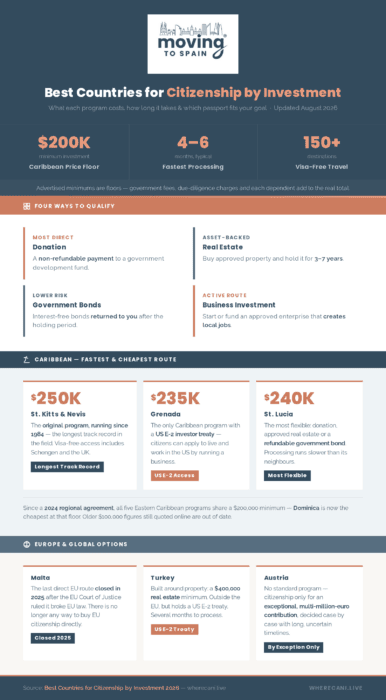
- Donation: A non-refundable payment to a government development fund. The most direct option.
- Real estate: Buying a property from an approved list and holding it for a set period, usually three to seven years.
- Government bonds: Buying interest-free government bonds that are returned to you after a required holding period. Lower risk, since you get the money back.
- Business investment: Starting a business that creates local jobs, or investing in an approved enterprise.
Not sure which investment visa route is best for you?
Jason Swan works exclusively on residency and citizenship by investment, and has guided hundreds of families through the process. He also made the move himself, from Spain to Portugal in 2021.
Free 30-minute call, no obligation. You will get a straight answer on which route fits, what it costs, and how long it takes.
Best Countries for Citizenship by Investment in the Caribbean
The Caribbean is the fastest and least expensive route to a second passport. Most programs run on two main options: a non-refundable donation to a national fund, or the purchase of approved real estate. Since a 2024 regional agreement, the five Eastern Caribbean programs share a minimum price of $200,000 for any option, so the figures below are floors, not the full cost once government fees and dependents are added.
Three of the most established options:
St. Kitts & Nevis: The Original Program
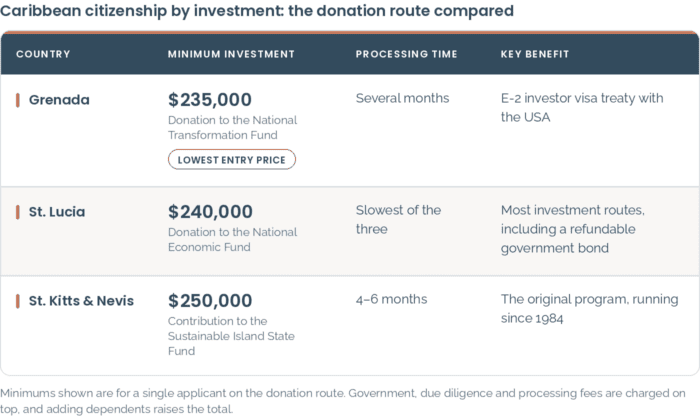
St. Kitts & Nevis launched the world’s first citizenship by investment program in 1984, which gives it the longest track record in the field. The minimum donation is $250,000. Citizens get visa-free access to more than 150 destinations, including the Schengen Area and the UK. Processing usually takes around four to six months.
Grenada: The Only Caribbean Program with E-2 Access to the USA
Grenada is the one Caribbean program with an E-2 investor treaty with the United States, so Grenadian citizens can apply to live and work in the US by running a qualifying business. That makes it the standout choice for entrepreneurs with US plans. The minimum donation is $235,000, with processing typically taking several months.
St. Lucia: The Most Flexible Option
St. Lucia offers more ways to qualify than the other programs, including a donation, approved real estate, and a refundable government bond, which suits applicants who want an option beyond a one-way donation. The minimum donation is $240,000. Processing tends to take longer here than in St. Kitts or Grenada.
European & Global Programs
Outside the Caribbean, the picture changes. The best countries for citizenship by investment outside of the Caribbean used to be through Malta, but that ended in 2025. What’s left at this tier are higher thresholds, stricter vetting, and countries that sit outside the EU.
Malta: This EU Route Has Closed
For years, Malta was the only EU member state offering citizenship through investment. That ended in 2025. On April 29, 2025, the EU Court of Justice ruled that Malta’s investor citizenship scheme broke EU law because it granted citizenship in exchange for payment without a genuine connection to the country. Malta wound down the program (known as MEIN) by July 2025 and moved toward a merit-based model. There is no longer a way to obtain EU citizenship directly through investment. If living in the EU is your goal, the route now runs through residency programs and standard naturalization, which require years of actual residence.

Turkey: Citizenship Through Real Estate
Turkey is outside the EU but runs one of the quicker programs, built mainly around property. The minimum is a $400,000 real estate investment. Turkey also holds an E-2 treaty with the United States, so Turkish citizens can become eligible to apply for the US E-2 investor visa, which appeals to entrepreneurs with US plans. Processing usually takes several months.
Austria: Citizenship by Exceptional Contribution
Austria has no standard investment program. Its law allows citizenship in rare cases for an exceptional contribution to the country, usually a multi-million-euro investment or a significant economic or cultural contribution, decided case by case. This isn’t something you apply to like a program, and timelines are long and uncertain.
The Core Benefits: Why Get a Second Citizenship?
A second passport does a few practical things. It widens where you can travel without a visa, gives your family another place to live if circumstances at home change, and can open up business and tax options. How much each one matters depends on your situation.
Visa-Free Travel
The main draw is mobility. A strong second passport gives you visa-free or visa-on-arrival access to 150 or more destinations, often including the Schengen Area, the UK, and hubs like Hong Kong and Singapore. For anyone who travels often for work, that removes a lot of visa paperwork.
A Backup Plan for Your Family
A second citizenship gives your family the option to live elsewhere if political or economic conditions at home deteriorate. It can also mean access to a different healthcare and education system. Whether those are better than what you have now depends entirely on the country, so check the specifics rather than assuming.
Tax and Business Considerations
A second citizenship can give you access to new markets and, in some cases, a more favorable tax setup. But citizenship is not the same as tax residency: where you pay tax usually depends on where you actually live, not which passports you hold. The tax side is complicated and varies by country and by personal circumstances, so get advice from a qualified tax professional before counting on any benefit.
How to Choose the Right Program
There’s no single best program. The right one depends on why you want a second passport, what you can spend, and who you’re including. Three things to work through.
Step 1: Define Your Goal
Start with why you want this. Your main goal points you toward different programs:
- Travel freedom: For visa-free access to 150-plus destinations, the stronger Caribbean passports like St. Kitts & Nevis or Dominica are the usual choice.
- US business access: Only Grenada’s E-2 treaty lets citizens apply to live and work in the US by running a business, which makes it the pick for that goal.
- Living in the EU: Citizenship by investment no longer offers a direct route here, since Malta’s program closed in 2025. That goal now means an EU residency program and naturalization over time, not a bought passport.
Step 2: Assess Budget and Timeline
The advertised minimum is only the starting point. Add government fees, due diligence charges, and legal costs to get the real number, and budget more for each family member you include. Timelines vary too. Caribbean programs are usually the fastest, often four to six months, while programs elsewhere can take longer.
Step 3: Due Diligence
Every credible program runs due diligence: checks on your identity, the source of your funds, and your criminal record. Those checks got stricter across the Caribbean after the 2024 reforms. Work only with a government-authorized agent, and treat certain things as warning signs, such as promises of guaranteed approval or pressure to pay through unofficial channels.
Before You Commit
The right program comes down to your specific goal, your real budget once fees are included, and who you’re bringing with you. The figures and rules here change often, as the 2024 Caribbean price increases and Malta’s 2025 closure both show, so confirm the current requirements before you commit and get advice from a qualified immigration professional on your own situation.
Frequently Asked Questions
What is the cheapest country to buy citizenship in?
Globally, the lowest-cost programs are smaller nations like São Tomé and Príncipe, where donations start around $90,000. In the Caribbean, the cheapest is now Dominica at $200,000, since the five Eastern Caribbean programs agreed a $200,000 floor in 2024. The older $100,000 figures still quoted on many sites are out of date. The total is higher once fees and dependents are added.
Which country has the fastest program?
Vanuatu is usually the quickest, often issuing passports in about one to two months. Several Caribbean programs run in roughly three to six months. Speed depends partly on the quality of your paperwork and how the background checks go.
Can my family get citizenship with me?
Yes. Most programs let you include your spouse and dependent children, and many also cover dependent parents, grandparents, and sometimes siblings. Each added person raises the total cost, and the exact rules differ by country.
Do I have to live in the country?
For most citizenship by investment programs, no. You can usually complete the process remotely without relocating, which is the main difference from residency by investment. A few programs have minor visit requirements, Antigua and Barbuda for example, so check the specific rules.
Is citizenship by investment legal and permanent?
Yes. These programs are set up under national law and run by the governments that offer them. Once granted, citizenship is generally permanent and can be passed to your children, though it can be revoked if it was obtained through fraud or false information.
Will I have to pay tax in my new country?
Holding a second citizenship does not automatically make you a tax resident there. Tax usually depends on where you actually live, not which passports you hold. The rules vary widely by country and by your own circumstances, so confirm your position with a qualified tax advisor before relying on any tax benefit.
How do I prove the source of my investment funds?
This is a standard part of due diligence and anti-money-laundering checks. You’ll typically provide documents such as bank statements, sale contracts for property or a business, employment contracts, or a letter from an accountant. A good agent will tell you exactly what’s needed for the program you choose.