
Dreaming of a life filled with sun-drenched siestas, vibrant culture, and delicious tapas? For many, Spain is the perfect destination, but the path to getting there can seem tangled in bureaucracy. If the thought of confusing financial requirements, endless paperwork, and the fear of a simple mistake derailing your application is holding you back, you’re in the right place. We understand that applying for the non lucrative visa spain can feel overwhelming, and that’s precisely why we created this guide.
We are here to turn that confusion into confidence. In this complete 2026 guide, we will walk you through every single step of the process. We’ll demystify the IPREM financial requirements, provide a clear checklist of documents, and outline the correct timeline for your application. By the end, you won’t just understand the requirements; you’ll have a clear, actionable roadmap to successfully obtain your visa and begin your exciting new life in Spain.
What is the Spain Non-Lucrative Visa (and is it right for you)?
Have you ever dreamed of swapping your daily routine for sun-drenched siestas, vibrant culture, and a more relaxed pace of life in Spain? If you have the financial means to support yourself without working, the non lucrative visa spain could be your perfect ticket to that dream. In simple terms, this is a long-stay residence permit designed for non-EU citizens who want to live in Spain for more than 90 days without engaging in any local professional or commercial activities.
Think of it as a “residency-only” visa. It’s not for someone looking for a job in Spain, but for those who can prove they have a steady, passive income or significant savings. Unlike the Digital Nomad Visa, which is for active remote workers, or the Golden Visa, which requires a substantial investment, the Non-Lucrative Visa (NLV) is all about demonstrating financial self-sufficiency. For a deeper dive into the exact 2026 requirements, our Spain Non-Lucrative Visa ultimate 2026 guide to residency covers everything you need to know.
Who is the Ideal Candidate for the Non-Lucrative Visa?
This visa is a fantastic opportunity for a specific group of people. Does this sound like you? You might be the perfect fit if you are:
- A retiree with a consistent pension or other retirement income.
- An investor or individual with substantial savings or passive income from sources like rental properties or dividends.
- A remote worker whose employer and clients are entirely based outside of Spain. (This is a crucial distinction from the Digital Nomad Visa).
- Someone wanting to take a year-long sabbatical to learn Spanish, travel, or simply immerse yourself in a new culture.
Key Benefits of Choosing the NLV
Beyond the simple joy of living in Spain, the NLV offers several powerful advantages that make it one of the most popular residency routes:
- Path to Permanency: The NLV provides a clear and established pathway to long-term residency and, eventually, Spanish citizenship after ten years.
- Bring Your Family: You can include your spouse or unmarried partner and dependent children on your application, allowing your whole family to start this new chapter together.
- Freedom to Travel: It grants you visa-free access to travel throughout the 29 countries in the Schengen zone, a freedom governed by the overarching Schengen Area visa policy.
- A Relaxed Lifestyle: By design, this visa allows you to settle into Spanish life without the pressure of finding local employment, giving you the time and freedom to truly enjoy your new home.
Financial Requirements: How to Prove Your Economic Solvency
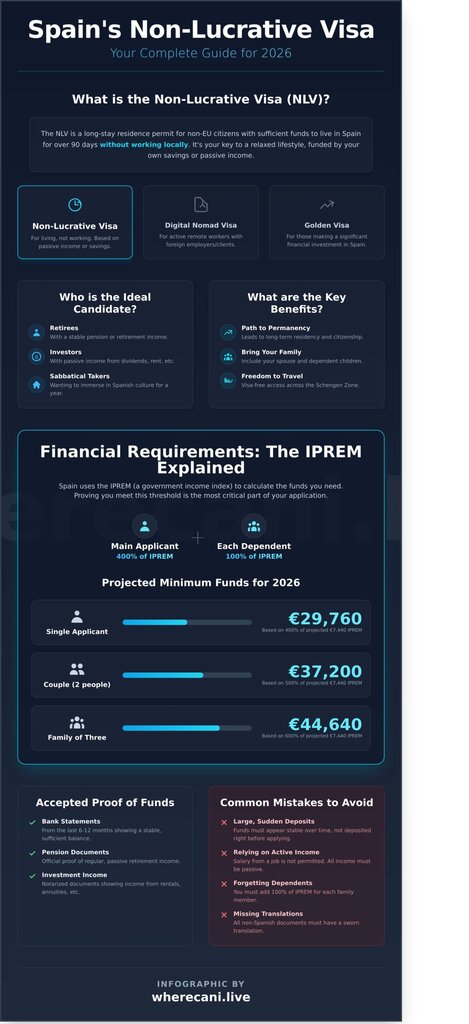
Let’s tackle the most critical part of your application: proving you have sufficient financial means. This step often feels daunting, but we’re here to demystify it for you. The Spanish government needs to see that you can support yourself (and your family) without working. They measure this against a benchmark called the IPREM (Indicador Público de Renta de Efectos Múltiples).
The core requirement is to prove you have access to funds equivalent to 400% of the annual IPREM for the main applicant. For each additional family member you include, you must add another 100% of the IPREM. These figures are updated annually, and you can always cross-reference the latest requirements in the Official guide to the non-lucrative visa from the Spanish government.
Calculating Your Required Funds for 2026
While the IPREM is set annually, planning ahead is key. Based on recent trends, we can project the minimum funds you’ll likely need for 2026. Remember, showing more than the minimum is always a fantastic way to strengthen your application.
Projected Minimum Funds for 2026 (based on a projected IPREM of €7,440/year):
- Single Applicant: 400% of IPREM = €29,760
- Couple (2 people): 500% of IPREM (400% + 100%) = €37,200
- Family of Three: 600% of IPREM (400% + 100% + 100%) = €44,640
Accepted Ways to Prove Your Financial Means
You must provide official, verifiable documents to prove your economic solvency. The funds must be readily accessible and come from passive sources. For a successful non lucrative visa spain application, common forms of proof include:
- Bank statements from the last 6-12 months showing a stable, sufficient balance.
- Official documents proving a pension or other regular, passive income.
- Notarized documents showing income from investments, annuities, or rental properties.
Common Financial Mistakes to Avoid
Getting this part right is crucial. As experienced expats, we’ve seen simple errors cause unnecessary delays. Be sure to avoid these common pitfalls:
- Large, recent deposits: A sudden large sum of money in your account looks suspicious. Your funds should appear stable over time.
- Relying on active income: Salary from a job is not permitted. The income must be passive.
- Forgetting dependents: Ensure your total calculation includes the extra 100% of IPREM for each family member.
- Missing translations: All official documents not in Spanish must be translated by a sworn translator (traductor jurado).
The Complete Document Checklist for Your Application
Gathering your documents is the most crucial step in your non lucrative visa spain application. While the list might seem long, think of it as a detailed roadmap to your new life in Spain! Remember, this is a general guide, and it is absolutely essential to check the specific requirements of the Spanish consulate in your jurisdiction, as they can vary. For a detailed walkthrough, this excellent guide to the NLV from the non-profit Age in Spain offers fantastic, practical advice.
Core Application Forms & Personal Documents
These are the foundational documents for your identity and official application. Ensure every detail is accurate.
- National Visa Application Form & EX-01 Form: You’ll need to complete and sign both. The EX-01 is your application for the initial residency authorization.
- Valid Passport: Must be valid for at least one year from your intended date of entry into Spain and have at least two blank pages for the visa.
- Passport-Sized Photographs: Recent, color photos with a white background that meet the consulate’s specific size requirements.
- Proof of Visa Fee Payment: A receipt showing you have paid the required non-refundable application fees.
Health and Background Checks
Spain needs to know that you are in good health and have a clean record. These documents provide that assurance.
- Police Clearance Certificate: From your country of residence (and any country you’ve lived in for over six months in the last five years). This must be recent and typically requires an Apostille of Hague.
- Medical Certificate: A recent letter from your doctor, on their official letterhead, stating you are free from diseases that could pose a public health risk under International Health Regulations.
- Private Spanish Health Insurance: You must have a comprehensive policy with a company authorized in Spain. It must be valid for your first year and offer coverage equivalent to the Spanish public health system with no co-payments or deductibles. This means you pay nothing out-of-pocket for covered services.
Supporting Documentation
This is where you prove your case-showing you have the funds, motivation, and a place to live for your new Spanish adventure.
- Proof of Financial Means: As detailed in the previous section, you’ll need bank statements, investment reports, or other documents proving sufficient funds.
- Letter of Intent (Carta de Motivación): A personal letter explaining why you want to move to Spain and confirming you will not undertake any lucrative work.
- Proof of Accommodation: Evidence of where you will live, such as a signed 12-month rental contract or a property deed (nota simple).
A final crucial tip: Any official documents not in Spanish (like your police check) must be translated by an official sworn translator (traductor jurado) recognized by the Spanish government. Planning for translations and Apostilles early will make your application process much smoother.
The Step-by-Step Application Process: From Consulate to Spain
You’ve done the research and confirmed the requirements; now it’s time for action. We know this part can feel daunting, but breaking the process down makes it entirely manageable. Think of it as a four-part journey to your new life in the sun. Let’s walk through it together, step by step.
Step 1: Gather, Translate, and Legalize Your Documents
This is the most time-consuming phase, so we recommend starting at least 3-4 months before you plan to move. Key documents like your criminal record check will need an Apostille of the Hague to be valid internationally. Any documents not in Spanish must be translated by an official sworn translator (traductor jurado). Meticulous preparation here is the secret to a smooth application.
Step 2: The Consulate Appointment
Once your dossier is complete, you’ll book an appointment at the Spanish Consulate with jurisdiction over your place of residence. During the appointment, you will submit your application and all supporting documents (always bring originals and copies). Be prepared for a brief interview where an official may ask about your motivations for moving to Spain. Confidence and organization are key!
Step 3: Visa Approval and Arriving in Spain
The waiting period for your non lucrative visa spain can take up to three months, so patience is essential. Once approved, the consulate will place a visa sticker in your passport. This visa is your ticket to enter Spain, and you have 90 days from its start date to make your move. Upon arrival, your first priority should be registering your address at the local town hall, a process called empadronamiento.
Step 4: Obtaining Your TIE (Foreigner Identity Card)
Within 30 days of arriving in Spain, you must apply for your Foreigner Identity Card, or TIE (Tarjeta de Identidad de Extranjero). This is a mandatory step that formalizes your residency. You’ll need to book an appointment (cita previa) online at a local immigration office or police station. For your appointment, you will typically need:
- Your passport and visa
- The TIE application form (EX-17)
- Proof of the fee payment (Modelo 790-012)
- A recent passport-sized photo
- Your empadronamiento certificate
While the process for the non lucrative visa spain has many steps, each one is a milestone bringing you closer to your dream. If you need expert guidance to ensure every detail is perfect, our network of vetted immigration partners at Where Can I Live is here to help.
Life on the NLV: Renewals, Taxes, and Your Path to Residency
Congratulations! Securing your visa is a massive achievement, but it’s just the first step in your new life in Spain. Understanding what comes next-from renewing your stay to handling your taxes-is key to a smooth and successful transition. Think of your initial visa as the foundation for a much bigger, more permanent adventure.
Here’s what you need to know about life after your initial approval for the non lucrative visa spain.
Renewing Your Non-Lucrative Visa
Your first residence permit is valid for one year. After that, the renewal process follows a clear pattern, designed to reward your commitment to living in Spain. The path looks like this:
- First Renewal: Valid for two years.
- Second Renewal: Valid for another two years.
To qualify for renewal, you must prove that you still meet the core requirements. This includes showing you have sufficient financial means for the upcoming two-year period and maintaining private Spanish health insurance. Crucially, you must also demonstrate that you have lived in Spain for at least 183 days during each year of your residency.
The Path to Permanent Residency and Citizenship
The non lucrative visa spain is a fantastic pathway to long-term stability. After five years of continuous legal residence, you become eligible to apply for long-term (permanent) residency. This is a game-changer, as it grants you the right to live and work in Spain indefinitely without further renewals.
Looking even further ahead, you may be eligible to apply for Spanish citizenship after 10 years of legal residency. This timeline can be shorter for citizens of certain countries, such as those from Ibero-American nations, who may be able to apply after just two years.
Understanding Your Tax Obligations
One of the most important aspects of your new life is understanding your tax responsibilities. If you live in Spain for more than 183 days in a calendar year, you are considered a tax resident. This means you are liable for Spanish taxes on your worldwide income, not just income sourced from Spain.
Navigating international tax treaties and Spanish tax law can be incredibly complex. To ensure you remain compliant and optimize your financial situation, we strongly recommend seeking professional advice. Don’t leave it to chance. Connect with an expert here.
Your Spanish Dream is Within Reach
Embarking on your move to Spain is an incredible adventure, and as you’ve seen, the non lucrative visa spain offers a fantastic pathway to make it happen. The key takeaways are clear: success hinges on demonstrating sufficient economic solvency and meticulously preparing every single document on your checklist. By understanding the complete process, from your initial consulate appointment to your first renewal in Spain, you transform a potentially overwhelming task into a series of achievable steps.
We know that even with a detailed guide, navigating the bureaucracy can feel daunting. That’s why our advice comes from fellow expats who’ve been exactly where you are now. Our free guides are designed to demystify your move, and we connect you with a vetted network of trusted immigration partners to provide expert support when you need it most.
Feeling overwhelmed or just want a professional to review your plans? Connect with a vetted Spanish immigration expert for a consultation.
Your new life of sunshine, culture, and adventure is waiting. With the right preparation and a little help, you can confidently take that next step toward making your dream a reality.
Frequently Asked Questions About the Spain Non-Lucrative Visa
Can I work remotely for a foreign company on a Spain Non-Lucrative Visa?
This is a common question, and the answer is technically no. The Non-Lucrative Visa is for individuals who can financially support themselves without working in or from Spain. Remote work is still considered a professional activity. If you engage in remote work, you risk having your visa renewal denied. For those who want to work remotely, Spain’s Digital Nomad Visa is the correct and legal pathway to explore for your journey.
How long does the entire Non-Lucrative Visa application process take?
The total timeline can vary based on your local Spanish consulate’s processing speed and how quickly you can gather your documents. It’s wise to plan for a period of 3 to 5 months from start to finish. Document preparation, including translations and apostilles, can take 1-2 months. After you submit your application, the consulate typically takes another 1-3 months to issue a decision. Starting early is key to a stress-free process.
What is the best type of health insurance for the Spanish NLV?
You must obtain a private Spanish health insurance policy that offers coverage similar to the public healthcare system. The policy must be valid for your full first year in Spain and, crucially, have no co-payments (“sin copagos”) or deductibles. It must be issued by an insurance company authorized to operate in Spain. Many providers offer specific plans designed to meet these visa requirements, so always confirm this before you purchase your policy.
Can I include my unmarried partner or adult children on my application?
Including family is possible, but with specific rules. You can include a spouse and minor children. For an unmarried partner, you’ll need to prove a stable, registered partnership, such as a “pareja de hecho.” Adult children can only be included if you can demonstrate they are still financially dependent on you and part of your household unit, for example, a full-time student or someone with a disability. Each family member must meet all individual requirements.
What are the most common reasons for a Non-Lucrative Visa to be rejected?
Rejections often stem from a few common mistakes. The primary reasons include failing to demonstrate sufficient and stable financial means, submitting an incorrect health insurance policy (e.g., one with co-payments), or having a recent criminal record. Another frequent issue is a weak motivation letter that doesn’t clearly explain your intentions. Carefully double-checking every document against the consulate’s checklist is the best way to ensure your success.
Can I switch from a Non-Lucrative Visa to a work permit later?
Yes, and this is one of the fantastic benefits of this visa path. After you have legally resided in Spain for one year on your non-lucrative residency permit, you are eligible to apply to modify your status. You can switch to a permit that allows you to work for a Spanish company or to become self-employed (“autónomo”). This flexibility makes it a great starting point for those who might want to work in the future.
Do I need to have my financial proof in a Spanish bank account?
For the initial visa application at your home country’s consulate, you do not need a Spanish bank account. You can use certified bank statements from your home country to prove you meet the financial requirements for the non lucrative visa spain. However, once you arrive in Spain to get your residency card (TIE), opening a local bank account will be necessary for managing your finances and is highly recommended for daily life.