
Dreaming of swapping your home office for a sun-drenched terrace in Valencia? The idea is incredible, but the reality of the visa application can feel overwhelming. Jargon-filled government websites, confusing income requirements, and the nagging fear of a rejected application can quickly turn your Spanish dream into a source of stress. If you’re wondering how to navigate the process with confidence, you’ve come to the right place. We created this guide to demystify the spain digital nomad visa and put you on the fast track to success.
We are here to guide you every step of the way. In this article, we break down everything you need into simple, actionable steps. You’ll discover a clear checklist for every required document, learn exactly how to prove your income as a freelancer or remote employee, and understand the timeline, costs, and fantastic tax benefits involved. Forget the confusion and anxiety; by the time you’re done reading, you’ll have a clear roadmap to successfully apply and start your new life in Spain.
Key Takeaways
- Quickly assess if you qualify by understanding the four non-negotiable pillars, from income thresholds to proof of remote work.
- Discover the two distinct application pathways and learn which one is the smarter, faster choice for your specific situation.
- Understand the crucial next steps after your spain digital nomad visa is approved, including navigating the special tax regime and setting up your new life.
- Find out how to avoid common pitfalls and costly mistakes that can delay or derail your dream of moving to Spain.
What Is the Spain Digital Nomad Visa? A Quick Overview
Ever dreamed of swapping your home office for a sun-drenched café in Barcelona or a quiet village in Andalusia? Thanks to a new residence permit, that dream is more accessible than ever. Spain’s answer to the global remote work trend is the Digital Nomad Visa, a pathway designed specifically for non-EU citizens who want to live in Spain while working for companies located anywhere else in the world.
This visa is perfect for a wide range of professionals, including remote employees, freelancers with international clients, and self-employed individuals. It grants you the legal right to live and work from Spain, initially for one year, with the possibility to renew for up to five years. This makes it a fantastic long-term option for building a life here.
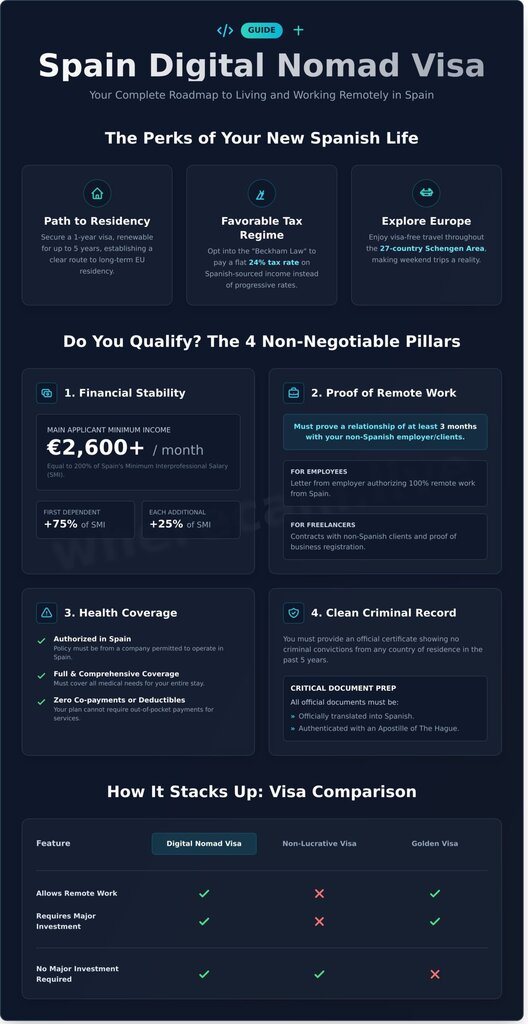
It’s important not to confuse the spain digital nomad visa with other popular options. Unlike the Non-Lucrative Visa, it explicitly allows you to work remotely. And unlike the Golden Visa, it doesn’t require a massive financial investment in property. It’s a modern solution for a modern workforce.
Key Benefits for Remote Workers
Beyond the incredible lifestyle, this visa offers tangible advantages that make moving abroad easier and more rewarding. Here are the standout perks:
- A Path to Residency: This isn’t just a temporary stay. The visa provides a clear route to long-term residency in a major European country, allowing you to put down roots.
- Favorable Tax Regime: Visa holders can apply for a special tax regime (often called the “Beckham Law”), paying a flat tax rate of 24% on Spanish-sourced income instead of the progressive standard rates.
- Freedom to Explore Europe: As a resident of Spain, you gain visa-free travel access throughout the 27-country Schengen Area, making weekend trips to Paris, Rome, or Lisbon a reality.
Who Is Eligible to Apply?
While the requirements are detailed, the core eligibility criteria are straightforward. We’ll dive deeper into the specifics later in this guide, but you generally need to meet these conditions:
- Be a Non-EU Citizen: The visa is for nationals from countries outside the European Union, EEA, or Switzerland.
- Prove Remote Work: You must demonstrate a stable work relationship for at least three months with a company located outside of Spain or show a roster of international clients if you’re a freelancer.
- Meet Financial Thresholds: You’ll need to prove you earn sufficient income to support yourself, along with having a clean criminal record and private health insurance.
Core Requirements for 2026: Do You Qualify?
Dreaming of working from a sun-drenched Spanish plaza? First, let’s see if you meet the core requirements for the spain digital nomad visa. The process is straightforward if you have your documents in order, but the criteria are non-negotiable. Think of it as four essential pillars: stable income, proven remote work, comprehensive health coverage, and a clean criminal record. Remember, a crucial step for all your documents is getting them officially translated into Spanish and authenticated with an Apostille of The Hague.
Financial Requirements: Proving Your Income
Spain needs to know you can support yourself without relying on the local economy. For 2026, you must demonstrate a minimum monthly income equivalent to 200% of Spain’s Minimum Interprofessional Salary (SMI). This currently amounts to around €2,600 per month (approx. $2,800 USD). If you plan to bring family, this amount increases: you’ll need an additional 75% of the SMI for your first dependent (spouse or child) and 25% for each subsequent person. You can prove this with documents like:
- Bank statements from the last 3-6 months
- Work contracts specifying your salary
- Recent client invoices and payment receipts if you are a freelancer
For freelancers, demonstrating consistent income across multiple clients and bank accounts can be particularly challenging. The good news is that financial technology is making this easier. Modern fintech solutions, often built on powerful bank aggregation APIs, can help consolidate financial data for clearer reporting. For those interested in the technology powering these advancements, you can discover Wealthreader and its role in creating a more connected financial ecosystem.
Proof of Remote Work: For Employees vs. Freelancers
You must prove that you have a stable, ongoing remote work arrangement. The requirements differ slightly depending on your employment status. Critically, you must demonstrate a professional relationship of at least three months with your employer or clients before applying.
- For Employees: You’ll need an official letter from your non-Spanish employer explicitly authorizing you to work 100% remotely from Spain.
- For Freelancers: You must provide contracts with one or more clients outside of Spain, along with proof of your business registration and professional qualifications.
- A professional website showcasing your portfolio and testimonials can be a powerful tool to legitimize your business, which is why many freelancers work with design agencies like Worth It Websites to build their online presence.
Health Insurance & Criminal Record Checks
Your well-being and security are paramount. You are required to have a comprehensive private health insurance policy from a company authorized to operate in Spain. This policy must cover you fully for the duration of your stay, with no co-payments or deductibles. Finding the right provider can be tricky, so we recommend you learn about choosing the right expat health insurance to ensure you meet the strict criteria. Additionally, you must provide a clean criminal record check from every country you have lived in for more than six months over the past five years. These specific security checks, as outlined by the Official Spanish Government, are a standard part of the process to ensure the safety of all residents.
The Application Process: A Step-by-Step Walkthrough
Navigating the application for your spain digital nomad visa can feel complex, but we’re here to break it down into manageable steps. The most important decision you’ll make is choosing your application pathway. Spain offers two distinct routes, each with its own advantages, depending on your personal timeline and planning style.
Path 1: Apply from your home country. This involves applying for a one-year visa at a Spanish Consulate. The major benefit is having your visa approved before you move, offering complete peace of mind. Once in Spain, you’ll convert this visa into a residence permit.
Path 2: Apply from within Spain. You can enter Spain legally (for example, as a tourist) and then apply for a three-year residence permit directly. This route is often faster and grants a longer initial stay, but it means traveling to Spain before your residency is guaranteed.
Before You Apply: Get Your NIE Number
Think of the NIE (Número de Identificación de Extranjero) as your all-purpose identification number in Spain. You’ll need it for nearly every official task, from opening a bank account to signing a lease. You can apply for your NIE at a Spanish consulate before you arrive or at a designated police station in Spain. Getting this sorted out first is a crucial step that simplifies all future bureaucracy.
Gathering, Translating, and Apostilling Your Documents
This is where your organizational skills shine. Most of your key documents from outside Spain will need to be officially translated and legalized. Here is a general checklist of what to prepare:
- A completed visa application form
- Passport valid for at least one year
- Proof of funds showing at least 200% of Spain’s minimum monthly wage
- Proof of remote work for a non-Spanish company (employment contract or client agreements)
- A clean criminal record check from the last five years
- Proof of qualifying private health insurance in Spain
- A university degree or proof of at least three years of relevant professional experience
Remember, documents like your criminal record check must be legalized with an Apostille of the Hague. Furthermore, any document not in Spanish must be translated by an official “sworn translator” (traductor jurado). For the most current and detailed checklist, always refer to the Official Digital Nomad Visa Requirements published by the Spanish government.
Submitting Your Application and Awaiting a Decision
If applying from home, you’ll book an appointment at your local Spanish consulate to submit your file in person. If applying from within Spain, the process is modern and efficient-you or your legal representative will submit everything digitally through the UGE-CE online platform. After submission, the typical processing time is between 20 and 45 business days. Now, you can take a deep breath and wait for the good news!
Life After Approval: Taxes, Residency Cards, and Banking
Congratulations! Holding your approved visa is a massive achievement, but it’s also where the next chapter of your adventure begins. Moving abroad is a journey, not a destination, and settling into your new life in Spain involves a few crucial administrative steps. Don’t worry, we’re here to guide you through what comes next, making your transition as smooth as possible.
Understanding the ‘Beckham Law’ Tax Benefit
One of the most significant advantages for holders of the Spain digital nomad visa is the special tax regime, often called the ‘Beckham Law.’ In simple terms, this allows you to be taxed as a non-resident for your first six years. You’ll pay a flat 24% tax on your Spanish-sourced income (up to €600,000) while your foreign income is generally not taxed in Spain. This can lead to substantial savings, but the rules are specific. We always recommend you get professional Spain tax advice to see if you qualify and to ensure you are fully compliant.
Your First 90 Days: Getting Your TIE Card
Once you arrive in Spain, one of your first and most important tasks is to get your TIE (Tarjeta de Identidad de Extranjero). This is your physical residency card and official ID. You must apply for it within 30 days of arrival. The process is straightforward but requires attention to detail:
- Book an Appointment: Secure a “Toma de Huellas” (fingerprinting) appointment at the local foreigner’s office or police station.
- Prepare Your Documents: You will typically need your passport, the visa approval letter, a completed EX-17 form, passport-sized photos, and proof of payment for the administrative fee (Modelo 790-012).
- Attend and Collect: At your appointment, you will submit your documents and provide your fingerprints. You’ll be given a receipt and told to return in approximately 30-45 days to collect your shiny new TIE card.
Practicalities: Opening a Bank Account
A Spanish bank account is essential for everyday life, from paying rent and utility bills to handling your local taxes. While some banks may allow you to open a non-resident account before you arrive, it’s often easier once you have your TIE application receipt (resguardo). You’ll typically need your passport, NIE (Foreigner’s Identity Number), and proof of address in Spain.
Once your account is active, you’ll need to transfer funds. To make sure you get the best rates and lowest fees, use our guide on the best ways to send money internationally to fund your new life in the sun.
How to Ensure a Smooth and Successful Application
Navigating the requirements for the spain digital nomad visa can feel complex, and we understand that it can be daunting. Your dream of living and working in Spain is too important to leave to chance. While it’s possible to manage the process alone, a single mistake can lead to frustrating delays or even a denial. Investing in expert guidance isn’t an expense; it’s an investment in your peace of mind and a faster path to your new life abroad.
Common Mistakes That Can Derail Your Application
After helping countless people move abroad, we’ve seen where applications most often go wrong. Getting your spain digital nomad visa application right the first time means avoiding these common pitfalls:
- Incorrect Document Formalities: Submitting documents without the required sworn translations (traducción jurada) or the Apostille of The Hague is one of the quickest ways to have your application returned.
- Inadequate Health Insurance: Simply having any private health insurance isn’t enough. It must be with a company authorized to operate in Spain and provide full coverage with no co-payments (sin copagos), mirroring the public health system.
- Insufficient Proof of Income: Failing to clearly and correctly demonstrate your income and the stability of your remote work is a major red flag for officials. Your financial evidence must be impeccably organized and meet the specific thresholds.
Why Consider an Immigration Expert?
Imagine submitting your application with complete confidence. That’s the value an immigration expert provides. They live and breathe Spanish bureaucracy, so you don’t have to. A vetted professional ensures every form is perfect, every document is correctly certified, and your case is presented in the strongest possible way. They save you invaluable time and stress, acting as your trusted guide on the ground.
Your Next Step to Living in Spain
The opportunity to live in Spain-with its vibrant culture, incredible food, and beautiful landscapes-is within your reach. Don’t let paperwork stand in the way of your dream. You can take the next step with clarity and confidence.
At Where Can I Live, we specialize in making your move abroad easy. We can connect you with our trusted, English-speaking immigration lawyers in Spain who have a proven track record of success. Let us help you get started.
Find out more and get a free introduction to our vetted Spanish immigration partner today.
Your Spanish Dream is Within Reach
Embarking on your journey to live and work remotely from Spain is an incredibly exciting prospect. As we’ve covered, success comes down to a few key steps: understanding the core requirements for 2026, navigating the application process with care, and preparing for your new life after approval. While the details can seem complex, this guide is designed to demystify the process and make your goal feel achievable.
But you don’t have to do it all alone. As serial expats ourselves, we built Where Can I Live to provide the tools and resources we wished we had. Our guides are written from real-world experience, and our vetted network of immigration experts is here to ensure your application for the spain digital nomad visa is as smooth and successful as possible.
Get expert guidance on your application. Talk to our vetted Spanish immigration partners today.
Your new life of sunshine, tapas, and culture is waiting. With the right preparation and support, you can turn that dream into your reality. We’re here to help you get there.
Frequently Asked Questions About the Spain Digital Nomad Visa
Can I bring my family with me on the Spain Digital Nomad Visa?
Yes, absolutely! One of the fantastic benefits of the spain digital nomad visa is that you can bring your family. This includes your spouse or registered partner and any dependent children. You will need to prove you have the financial means to support them, which means the minimum income requirement will be higher for each family member you include. It’s a wonderful way to ensure your loved ones can join your Spanish adventure.
How long does the entire application process take from start to finish?
While timelines can vary, it’s wise to plan for a few months. From gathering your documents to receiving a decision, most applicants find the process takes between two to four months. The official decision period is around 20 working days once your application is submitted, but collecting, translating, and legalizing all the required paperwork can take considerable time beforehand. Our best advice is to start early to ensure a smooth, stress-free process.
What is the exact minimum income I need to prove in 2026?
The income requirement is tied to Spain’s minimum interprofessional salary (SMI), which is updated annually. For 2026, you will need to prove a monthly income of at least 200% of the SMI. Based on current trends, this will likely be around €2,600 per month for the main applicant. For the first family member, you’ll need an additional 75% of the SMI, and 25% for each subsequent member.
Can I work for a Spanish company while on the Digital Nomad Visa?
This visa is primarily for remote work with non-Spanish companies. However, the law provides some flexibility, allowing you to earn up to 20% of your total professional income from a company based in Spain. Your main source of income must remain from foreign clients or employers. It is crucial to stay below this 20% threshold to remain compliant with the visa regulations and ensure a smooth renewal process in the future.
What are the most common reasons for an application to be denied?
Applications are most often denied due to simple but critical errors. The most common reasons include failing to meet the minimum income requirement, not having compliant private health insurance, or submitting incomplete paperwork. Another frequent issue is not providing officially translated or apostilled documents where required. Carefully double-checking every detail against the official checklist is the best way to ensure your application is successful on the first try.
Do I need to speak Spanish to apply for the visa?
No, there is no language requirement to be granted the visa. You can submit your application and all supporting documents with official Spanish translations. While you don’t need Spanish for the paperwork, we highly encourage learning some basic phrases. It will make your transition much easier and help you connect with the local culture, turning your move into a truly rich and immersive experience from day one.
Is it better to apply from my home country or from within Spain?
You have both options, and the best choice depends on your circumstances. Applying from a Spanish consulate in your home country grants you a one-year visa. Applying from within Spain while you are here legally (e.g., as a tourist) allows you to get a three-year residency permit right away. The in-country application is often preferred as it provides a longer initial residency and can be a faster path to settling in.
How do I renew the visa after the first year?
If you received a one-year visa by applying from your home country, you will apply to convert it into a three-year residency permit before it expires. This renewal is done within Spain. You’ll need to demonstrate that you still meet all the original requirements, such as the income threshold, private health insurance, and your remote work status. This process is generally more straightforward than the initial application as you are already in the system.