


Imagine it’s January 2026. You’ve just received a job offer from a top-tier firm in London, but instead of celebrating, you’re staring at a government website wondering if you actually meet the uk skilled worker visa eligibility rules. It’s a common worry. We know that the constant shifts in immigration policy, like the salary hikes seen in 2024 and 2025, can make your dream of moving to Britain feel like it’s slipping away. You’ve invested months of effort, and the last thing you want is a rejection letter because of a technicality you didn’t see coming.
We’re here to help you turn that stress into a clear plan of action. You’ll master the 2026 UK points-based system and discover exactly how to meet every eligibility requirement for your move. We’ll break down the 2026 salary thresholds, show you how to find a licensed sponsor, and provide a proven roadmap to ensure your application is successful. You’ll finish this guide with a clear “yes” or “no” understanding of your status and the confidence to take the next step toward your new life with a trusted partner by your side.
Key Takeaways
- Understand the 2026 points-based model and how the evolution of the UK’s immigration system affects your path to residency.
- Master the five non-negotiable criteria, including how to secure the Certificate of Sponsorship that acts as your golden ticket for entry.
- Navigate the new 2026 salary thresholds and occupation codes to ensure you meet every uk skilled worker visa eligibility requirement for your specific role.
- Prepare for a smooth application journey with a comprehensive checklist of essential documents and a clear timeline from job offer to arrival.
- Go beyond the visa with a proven relocation strategy and discover how to access vetted expert advice to simplify your move to the UK.
What is the UK Skilled Worker Visa in 2026?
The UK Skilled Worker visa is the primary route for international talent to live and work in Britain. It allows you to work for a specific employer approved by the Home Office, provided the role meets certain criteria. This system replaced the old Tier 2 (General) route on January 1, 2021. If you explore the history of UK work permits, you’ll notice a clear transition from a rigid, quota-heavy system to this flexible, points-based model. By 2026, the framework has matured to prioritize high-skill professionals who contribute directly to the UK’s high-wage economy.
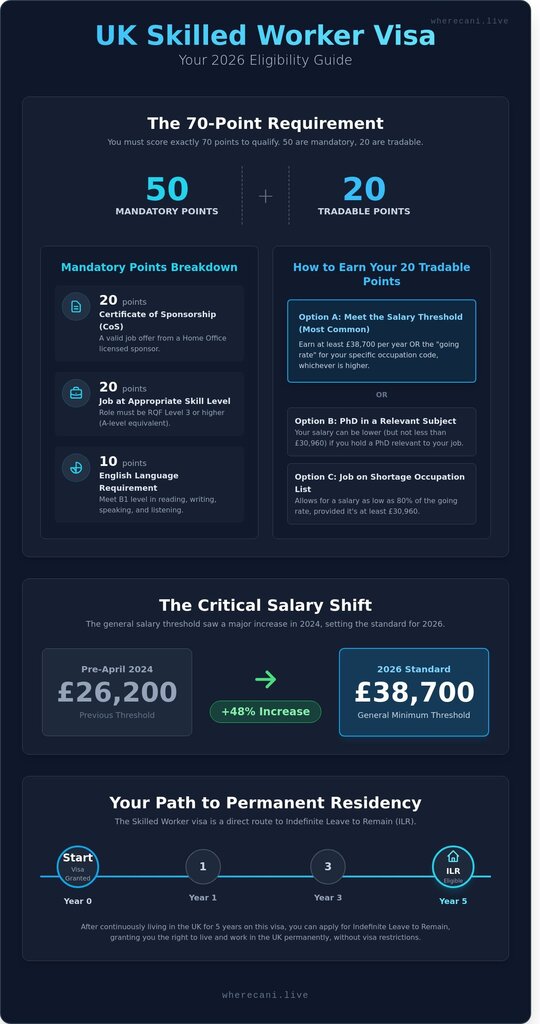
The 2024 policy shifts were a major turning point for the visa. On April 4, 2024, the government increased the general salary threshold from £26,200 to £38,700 for most applicants. This 48% jump changed the game for many people looking to move. For you, it means checking your uk skilled worker visa eligibility is more critical than ever. The current philosophy focuses on attracting specialists who fill genuine labor gaps while ensuring the local market remains protected. For those who meet these higher standards, the path is now more predictable and stable than it was during the post-Brexit transition years.
Moving to a new country is a huge decision, but the Skilled Worker route offers a structured way to make it happen. It’s designed to be a “win-win” scenario. The UK gets the expertise it needs in sectors like green energy and artificial intelligence, and you get the opportunity to build a career in one of the world’s most vibrant economies. It’s about more than just a job; it’s about finding a place where your skills are truly valued.
The Points-Based System Explained
To qualify for this visa, you must score exactly 70 points. Think of this as a mandatory checklist where 50 points are non-negotiable. You earn 20 points for having a valid Certificate of Sponsorship (CoS) from a licensed employer. Another 20 points come from your job being at the required skill level, known as RQF Level 3 or higher. The final 10 mandatory points are for meeting the English language requirement at level B1. You can’t skip these. If you don’t have a sponsor or your English isn’t at the right level, the application won’t move forward.
The remaining 20 points are “tradable.” Most applicants get these by meeting the standard salary threshold of £38,700. However, if your salary is lower, you can still reach 70 points if you have a PhD relevant to the job or if you work in a specific “Shortage” occupation. This flexibility is why the system is called “points-based” rather than a rigid set of rules. It allows the UK to be selective while still being open to the world’s best talent.
Who is this Visa For?
This route serves a diverse range of professionals. It’s not just for doctors and scientists; it includes tech engineers, architects, and even “Medium Skilled” roles like chefs or graphic designers. The RQF Level 3 requirement means many jobs requiring A-level equivalent skills are eligible. We see a huge variety of successful applicants, from secondary school teachers to software developers and project managers. If your role is on the list of eligible occupations, you’re halfway there.
This focus on quality-assured talent is a growing trend across Europe. For those exploring similar career paths in Norway, for example, the LetME platform offers a streamlined way to connect with employers in the hospitality and retail industries.
Best of all, this visa is a clear pathway to Indefinite Leave to Remain (ILR). After living in the UK for 5 years on this route, you can apply for permanent residency. This gives you the right to live and work in the UK without any further visa restrictions. It’s the ultimate goal for many expats we guide, providing the security and peace of mind needed to truly call the UK home. Checking your uk skilled worker visa eligibility today is the first step toward that permanent future.
The 5 Pillars of UK Skilled Worker Visa Eligibility
Understanding the uk skilled worker visa eligibility criteria is the first step toward your British dream. It’s not just about finding a job; it’s about meeting five specific, non-negotiable pillars that ensure your transition is smooth and compliant with current Home Office standards. These rules changed significantly on April 4, 2024, and the 2026 standards now require even more precision from applicants.
These five pillars form the foundation of your application. You must have a valid job offer from a licensed sponsor, the role must meet a specific skill level (RQF 3 or above), you must meet the minimum salary threshold, you must prove your English proficiency at a B2 level, and you must show you can support yourself financially upon arrival. Missing even one of these pillars will result in an immediate refusal, so let’s look at how to secure each one.
Finding an Approved UK Employer
Your journey starts with a licensed sponsor. You can’t just work for any company; the business must appear on the Home Office Register of Licensed Sponsors, which currently includes over 100,000 verified organizations. Once you have an offer, your employer will issue a Certificate of Sponsorship (CoS). In 2026, a valid CoS is a digital record with a unique reference number that confirms your salary, your specific SOC (Standard Occupational Classification) code, and an expiry date within three months of the issue. You must ensure your day-to-day duties align perfectly with the 2026 Eligible Occupations list, as the Home Office often performs “genuineness tests” to verify that the role isn’t being created solely to secure a visa.
The 2026 English Language Requirement (B2 Level)
Communication is key to a successful life in the UK. For 2026, the proficiency standard is set at the B2 level on the CEFR scale, which is an increase from previous years for certain sectors. This level ensures you can interact with native speakers with a degree of fluency and spontaneity. You’ll need to pass a test with an approved Secure English Language Test (SELT) provider, such as IELTS SELT Consortium, Pearson (PTE Academic UKVI), or LanguageCert. If you’re a national of a majority English-speaking country, like Australia, Jamaica, or the USA, you’re exempt from this test. You can find the full list of exempt countries and specific test requirements in the Official UK Government Guidance to ensure you’re booking the correct version of the exam.
Financial Maintenance Requirements
The Home Office wants to know you won’t fall into financial hardship while you settle in. The current “Personal Savings” rule requires you to show at least £1,270 in your bank account. You must hold the required £1,270 in your personal bank account for a minimum of 28 consecutive days, with the final day of this period falling within 31 days of your visa application date. However, many applicants bypass this by having their employer “certify maintenance” on the CoS. If your employer is “A-rated,” they can check a box on your sponsorship certificate promising to cover your costs up to £1,270 during your first month, which removes the need for you to provide personal bank statements.
If you’re feeling overwhelmed by the paperwork, don’t worry. Our team can help you find a vetted immigration expert to review your documents and ensure your application is airtight before you hit submit.
Salary Thresholds and Occupation Codes: The Math of Eligibility
Cracking the code of UK immigration requires a look at the numbers. On April 4, 2024, the Home Office implemented a major shift in how pay is calculated for sponsorship. Most applicants now face a “General Threshold” of £38,700. This is the baseline, but it isn’t the only figure you need to track. You must also meet the “Going Rate” for your specific job. If the going rate for your role is £45,000, you have to earn that higher amount to satisfy the uk skilled worker visa eligibility requirements. The system always defaults to whichever number is higher.
The math changes significantly if your job appears on the Immigration Salary List (ISL). This list replaced the old Shortage Occupation List in early 2024. If your role is on the ISL, your general salary threshold drops to £30,960. However, you still need to earn at least 80% of the specific going rate for that occupation. It’s a balancing act that requires checking the most recent Home Office spreadsheets to ensure your offer matches the current legal standards.
Navigating SOC Occupation Codes
Every sponsored job in the UK is tied to a four-digit Standard Occupational Classification (SOC) code. This code is the single most important factor in determining your minimum pay. If your employer assigns the wrong code, your application will fail. You can use the CASCOT tool or the ONS occupation coder to find where your job duties fit. Don’t rely on job titles alone. A “Manager” in one company might perform duties that the Home Office classifies as a “Senior Administrator.” Identifying the correct code is vital because many roles are simply ineligible for sponsorship. If your SOC code falls under skill level RQF 3 or above, you’re usually in the clear, provided the salary matches.
Tradable Points: When a Lower Salary Still Works
You don’t always need to hit the £38,700 mark. The system allows you to “trade” certain qualifications or characteristics for a lower salary requirement. For example, if you hold a PhD relevant to your job, your salary floor could drop to £34,830, which is 90% of the general threshold. If that PhD is in a STEM subject, the requirement drops even further to £30,960. This flexibility helps high-skilled researchers and scientists find their footing in the UK market without needing an immediate top-tier corporate salary.
If you’re currently finishing your studies in Britain, you might qualify as a “New Entrant.” This category is designed for people under 26, those switching from a Student visa, or those working toward professional qualifications. New Entrants only need to earn £30,960 or 70% of their job’s going rate. If you’re in this position, the UKCISA Skilled Worker Visa Guide is a fantastic resource for understanding how your student status impacts your transition to a work permit. This lower threshold is a temporary boost that lasts for up to four years, giving you time to grow your career and salary.
Special rules also apply to the Health and Education sectors. If your job is on a recognized national pay scale, such as a nurse, midwife, or secondary school teacher, the £38,700 threshold doesn’t apply to you. Instead, your pay must simply match the official scale for your grade and region. This ensures that vital public service roles remain accessible to international talent despite the 2024 price hikes. Understanding these nuances is the best way to confirm your uk skilled worker visa eligibility before you spend money on application fees.
This specialized consideration for health professionals can extend to other aspects of relocating, like buying a home. For example, specialist brokers providing Mortgages for Doctors understand the unique income structures within the NHS and private practice, which can simplify the process significantly.
The Application Journey: From Eligibility to Approval
Securing your job offer is a massive win. Now, you need to turn that offer into a legal right to live and work in Britain. We know the paperwork can feel daunting, but breaking it down into a clear timeline makes the process manageable. Once you’ve verified your uk skilled worker visa eligibility, your employer will issue a Certificate of Sponsorship (CoS). This digital document is the backbone of your application; you must apply within three months of receiving it to ensure it remains valid.
- Gather your documents: You’ll need a valid passport and proof of your English language proficiency at level B1 or higher.
- Health and safety: If you’re applying from a country on the Home Office’s specified list, such as South Africa or Thailand, you must provide a clear TB test result.
- Professional checks: Roles in education, healthcare, or social work require a criminal record certificate from every country you’ve lived in for 12 months or more over the last 10 years.
Beyond these official requirements, keep in mind that your UK sponsor will likely conduct their own comprehensive background check as part of their due diligence. To get a better sense of what this process involves for international candidates, you can find out more.
How long does it take? Standard processing for applications made outside the UK usually wraps up within 15 working days. If you’re in a hurry, the Priority service provides a decision in 5 working days for an extra £500 fee. For urgent moves, the Super Priority service delivers a result by the end of the next working day for £1,000. Don’t let simple mistakes slow you down. Roughly 14% of applications face delays because of mismatched salary data or missing bank statements showing the required £1,270 in personal savings held for 28 consecutive days.
Applying from Outside vs. Inside the UK
Are you already in the UK on a Graduate or Student visa? You can often “switch” to the Skilled Worker route without leaving the country. This is a popular path for many expats we work with. The main difference lies in the logistics; you’ll likely use a smartphone app for biometrics rather than visiting a physical center. You can’t start your new duties until your new visa is officially granted. If you’re currently working for a different sponsor, stay in your current role until the approval arrives to avoid breaching your conditions.
Visa Costs and the Immigration Health Surcharge (IHS)
Budgeting is essential for a stress-free move. For 2026, estimated application fees for a 3-year visa sit at £827, while a 5-year visa costs approximately £1,500. On top of this, you must factor in the Immigration Health Surcharge. This fee grants you full access to the National Health Service (NHS) just like a local resident. The IHS is currently £1,035 per year for adults. You must pay the full IHS amount upfront for the entire duration of your visa at the time of application. For a 5-year stay, this means a single payment of £5,175.
Ready to start your journey? Our experts can help you confirm your uk skilled worker visa eligibility and guide you through every step. Book a consultation with our vetted UK visa specialists today.
Moving Abroad Made Easy: Your UK Success Strategy
Securing your uk skilled worker visa eligibility is a massive achievement, but it isn’t the finish line. It’s the starting block. We’ve moved our lives across borders six times since 2000, so we understand the late-night anxiety that comes with a UK relocation. Alastair and Alison founded this platform to move beyond the cold, bureaucratic language of government websites. Our “Expat-to-Expat” approach is designed to reduce your stress by sharing lived experience. We act as your protective filter, ensuring you only work with partners who have passed our rigorous assessment process. You’re not just a case number to us; you’re a future expat embarking on a life-changing journey.
Expert Consultations and Legal Support
Deciding between a DIY application and hiring a professional depends on your specific case. If you have a straightforward job offer from a long-established Grade A sponsor, you might manage alone. However, data from the Home Office suggests that administrative errors remain a leading cause of delays. In October 2023, the UK government increased visa fees by roughly 15% to 20%, making a rejection an expensive mistake. If your employment history is non-linear or your sponsor is new to the system, professional help is vital. Our global immigration consultations link you to solicitors who understand the nuances of the 2024 salary threshold increases. We’ve blacklisted 12 providers in the last year alone because they didn’t meet our standards. You deserve a partner who protects your interests, not just their bottom line. We keep a “red list” of poor providers to ensure you don’t fall for common visa scams that target hopeful workers.
Logistics: Shipping, Health, and Finance
Logistics often feel like a second job. When you’re managing a move, timing is everything. Most families require 8 to 12 weeks to organize sea freight. Getting multiple international moving company quotes through our portal ensures you aren’t overpaying during peak summer relocation months. Shipping a three-bedroom house to the UK can cost between £4,000 and £9,000 in 2024, so comparison is essential.
Financial setup is another hurdle. Standard retail banks often charge 3% to 5% above the mid-market rate when you move your relocation fund. By sending money internationally through vetted currency specialists, you can save enough to cover your first month’s rent in London or Manchester. It’s about keeping your hard-earned money where it belongs. Finally, don’t overlook your family’s wellbeing. While the Immigration Health Surcharge (IHS) gives you access to the NHS, private expat health insurance provides a safety net. With NHS wait times for some specialists exceeding 18 weeks in early 2024, having private coverage ensures your transition to UK life is healthy and uninterrupted.
Confirming your uk skilled worker visa eligibility was the first step. Now, let us help you handle the rest. We’ve been in your shoes. We’ve felt the weight of the boxes and the confusion of the forms. We’re here to guide you through the logistics so you can focus on the excitement of your new British life. The kettle is on; let’s get you moved.
Take the Next Step Toward Your UK Career
Mastering the 70 point system is the first hurdle to clear for your move. You must confirm your job offer comes from one of the 100,000+ licensed sponsors and meets the 2026 salary threshold of £38,700 for most standard occupations. Understanding uk skilled worker visa eligibility is about more than just reading a list; it’s about precise execution. Our founders, Alastair and Alison, moved between 6 countries before building this platform to simplify your journey. We use a meticulous partner assessment process to handpick a network of legal professionals who specialize in complex cases. This means you get expert guidance without the stress of searching for a reliable advisor yourself. Your dream of living and working in Britain is closer than you think. Take control of your relocation today. Book a consultation with a vetted UK immigration expert today and start your journey with confidence. You have the skills to succeed, and we have the team to get you there.
Frequently Asked Questions
Can I apply for a UK Skilled Worker visa without a job offer?
No, you cannot apply without a confirmed job offer from a UK employer licensed by the Home Office. Your sponsor must issue a digital Certificate of Sponsorship that includes a specific reference number for your application. This document proves your role meets the uk skilled worker visa eligibility standards. Without this record, your application will be rejected immediately by immigration officials.
What is the minimum salary for a UK Skilled Worker visa in 2026?
The general salary threshold for 2026 is expected to remain at least £38,700 per year, following the rules set in April 2024. You might qualify for a lower rate of £29,000 if you’re a Health and Care worker or on a specific national pay scale. Your pay must also meet the 50th percentile “going rate” for your specific occupation code, whichever is higher.
How long does it take to get a decision on my UK visa application?
You’ll usually receive a decision within 3 weeks if you apply from outside the UK. For those already in the country, the standard processing time is 8 weeks. If you’re in a hurry, you can pay £500 for priority service to get a result in 5 working days. The super priority service costs £1,000 and delivers a decision by the end of the next working day.
Can I bring my partner and children on a Skilled Worker visa?
Yes, you can bring your husband, wife, civil partner, or unmarried partner and children under 18 to the UK. Each family member must make their own application and pay the healthcare surcharge. You’ll need to prove you have at least £285 for your partner; £315 for one child; and £200 for each additional child to support them without using public funds.
What happens if I lose my job while on a Skilled Worker visa?
If your employment ends, the Home Office will typically issue a letter that reduces your visa stay to 60 days. This countdown starts from the date the letter is issued, not your last day of work. You’ll need to find a new sponsor and apply for a fresh visa within this window. If you don’t find a new role or switch visas, you’ll have to leave the UK.
Is there an age limit for the UK Skilled Worker visa?
There’s no maximum age limit for this visa, though you must be at least 18 on the day you apply. Older professionals bring valuable experience that UK employers often seek. If you’re under 26, you might benefit from a lower salary requirement of £30,960 or 70% of the going rate. This “new entrant” status helps younger workers start their careers in Britain more easily.
Can I switch from a Student visa to a Skilled Worker visa?
You can switch to this route if you’ve finished your degree or have a confirmed graduation date within the next 3 months. This is a great way to transition from education to a career while staying in the country. You must ensure your new job offer meets the uk skilled worker visa eligibility requirements, specifically regarding the skill level and salary. It’s a popular path for international graduates.
How many points do I need for a UK Skilled Worker visa?
You need to score exactly 70 points to be eligible for the Skilled Worker visa under the points based system. You get 20 points for a job offer from an approved sponsor; 20 points for a job at the right skill level; and 10 points for speaking English at level B1. The final 20 points are usually earned by meeting the salary requirement, though you can trade points for a PhD.